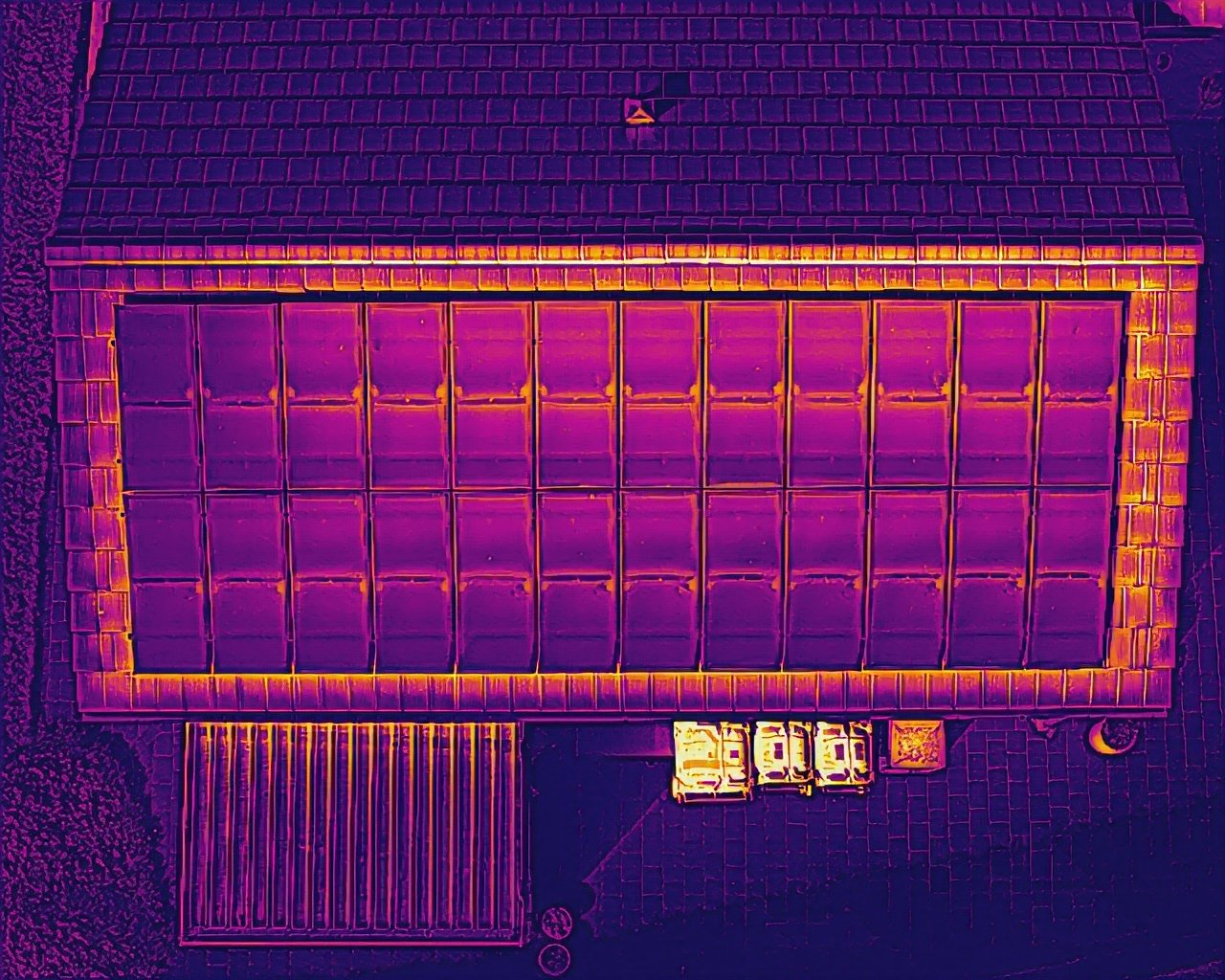
Solar panel inspection
If a photovoltaic system is operating with defective solar modules, it can become costly. Here is a summary overview of the most common faults and defects, briefly described:
- ✓
Hotspots (Individual Cells): Localized, extreme temperature increases on a single cell. They are often caused by internal short circuits, manufacturing defects, or cell damage.
- ✓
Micro-cracks (Cell Cracks): Small cracks in the silicon caused by transport, installation, or hail. They lead to increased electrical resistance and appear as irregular, warm patterns along the fracture lines.
- ✓
PID (Potential Induced Degradation): Voltage-related degradation that usually appears as a characteristic checkerboard pattern of heated cells along the module edges (strongest near the grounded frame).
- ✓
Defective Bypass Diode: If a bypass diode in the junction box fails, the current flow is blocked. This causes exactly one-third or two-thirds of the panel to heat up in a perfectly straight, rectangular block.
- ✓
Total Module Failure (Open Circuit): The entire solar panel appears uniformly warmer than the neighboring panels. This indicates that the panel is completely disconnected and is not producing power.
- ✓
Delamination: Separation of the protective layers in the panel. This allows moisture to penetrate, creating uneven heat zones and causing corrosion over time.
- ✓
String Outage: An entire string of panels appears warmer than the other strings. This is usually caused by a faulty inverter, a blown fuse in a combiner box, or a broken cable.
- ✓
Overheated Connectors (MC4 Connectors): Loose, corroded, or poorly mounted connectors create high resistance and appear as sharp, white spots on the thermal image.
- ✓
Reverse Polarity: String connections that were connected the wrong way round during installation, causing abnormal heating patterns at the string level.